
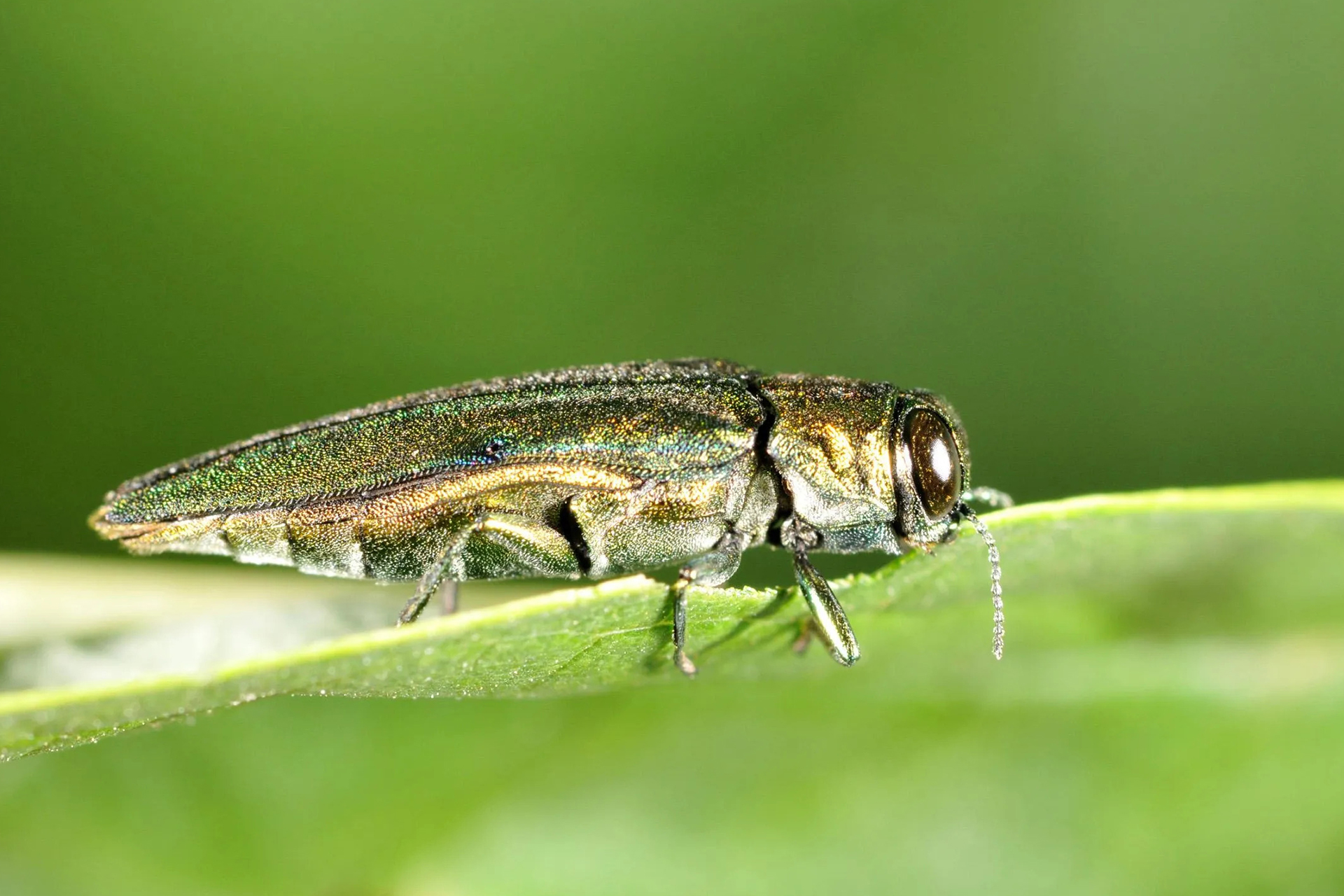
Discovered in 2002 in southern Michigan and Windsor area. Adult beetles are metallic green, about 1/2″ long, and may be seen feeding on foilage from June to August. They attack all species of ash and kills healthy ash trees of any size or age. They are well suited to Ontarios’ climate. The adults can flly several kilometers. They are also spread by people through movement of firewood, nursery stock, trees, logs, lumber or wood with bark attached.
Emerald Ash Borer
Dedicated team
Our commitment is unmatched in the industry
20 year experience
Proudly servicing our customers for 20+ years
Expert workers
An experienced team of tree care professionals
Chatham Tree Services
Preventing Emerald Ash Borer attack
Signs and Symptoms
- Tree canopy begins to die back in the upper third portion of the canopy
- Dieback progresses until the tree is bare
- Epicormic shoots (sprouts growing from roots and trunk)
- Bark splitting (vertical cracks and galleries exposed under the bark)
- Larval feeding galleries are typically serpentine and packed with frass (sawdust and excrement)
- D-shaped exit holes formed by adults
- Increased woodpecker activity creating large holes
Emerald Ash Borer Treatment
- TreeAzinTM Systemic Insecticide is injected into the base of ash trees using the EcoJect® System
- Treatments occur between mid May and early August
- An injection hole is 13/64” in diameter, approximately 3/4” to 1” into the wood
- Injection holes are approximately 6” apart 2 – 5 ml of TreeAzinTM Systemic Insecticide per cm tree diameter are injected into the tree
- Adult female Emerald Ash Borer beetles that feed on trees treated with TreeAzinTM Systemic Insecticide lay mostly sterile eggs, thus reducing populations
- Emerald Ash Borer larvae that consume tree tissues treated with TreeAzinTM Systemic Insecticide die in approximately 95% of cases
- Research in the Windsor area indicates injections every second year should keep trees alive through an outbreak
- Once Emerald Ash Borer populations decline, occasional injections may be recommended
- Preventing Emerald Ash Borer attack is less costly (lower dose) and increases the likelihood of trees surviving an outbreak
- Attacked trees can be protected if the damage is not too severe (<30% crown dieback)
- Treatments should be considered every second year unless the tree is already under attack, stressed, or high beetle populations are expected
Frequently Asked Questions
How do I know if my ash tree has emerald ash borer?
Look for canopy dieback starting in the top third of the tree and progressing downward until the tree is bare. Other symptoms include bark splitting, D-shaped exit holes, feeding galleries with frass in a serpentine pattern, and increased woodpecker activity. If you notice these symptoms, our emerald ash borer arborist in the Chatham-Kent area can confirm the problem. Early detection gives your tree the best chance.
Can an ash tree be saved from emerald ash borer?
Yes, if the damage is not too severe. Attacked trees can be protected when crown dieback is below 30%. Our ash tree treatment in Chatham, Ontario, uses TreeAzin™ Systemic Insecticide, injected at the base of the tree via the EcoJect® System. Prevention is less costly and increases the likelihood that a tree will survive an outbreak.
When should ash trees be treated for emerald ash borer?
Treatments are applied between mid-May and early August, when the insecticide is most effective. An emerald ash borer treatment in Chatham-Kent should be considered every second year, unless the tree is already under attack, stressed, or high beetle populations are expected. Research in the Windsor area indicates that injections every second year should keep trees alive through an outbreak.
Is emerald ash borer injection effective?
It is highly effective when applied correctly. With ash borer injection in Chatham, larvae that consume treated tree tissue die in approximately 95% of cases. Adult females that feed on treated trees also lay mostly sterile eggs, which reduces populations. This is why injection is a proven method for protecting healthy ash trees.
Should I remove an ash tree with EAB or treat it?
This depends on the severity. Less than 30% crown dieback may allow the tree to be saved, and a heavily infested tree may require removal. To save an ash tree in Chatham, treatment must begin before the damage becomes too advanced. Our certified arborists are available to evaluate your ash trees and advise you on the appropriate course of action.