
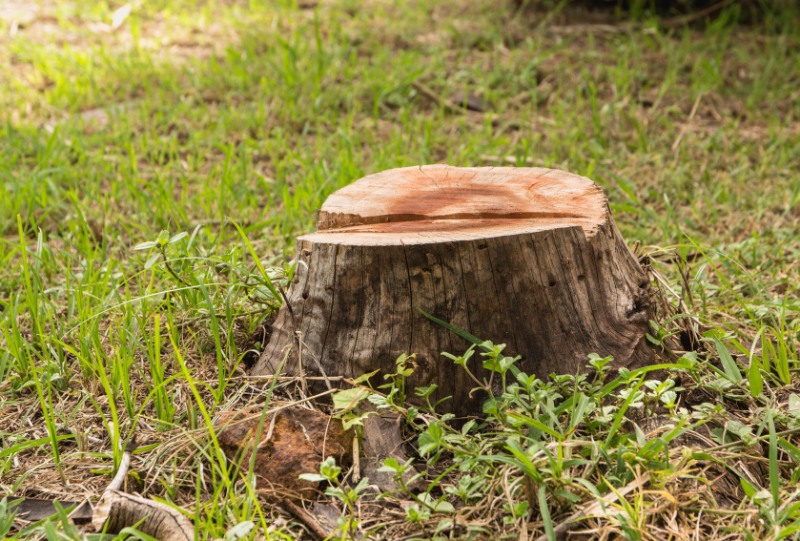
Stump grinding is the mechanical process of reducing a cut tree stump to wood-and-soil chips below grade while leaving most of the deeper root system in place. It quickly removes the visible obstacle, but the final result depends on grinding depth, what happens to the grindings, and how the hole is restored afterward.
Key Takeaways
• Chatham Tree Services describes its stump grinding process as taking the stump 6 to 8 inches below ground level.
• Stump grindings are a mixture of wood chips and soil; small amounts may remain in the hole, while larger volumes may be spread elsewhere or removed.
• For lawn restoration, removing most grindings and backfilling with topsoil gives grass a better start than seeding directly into a chip-heavy mix.
• Stump grinding removes the visible stump and some nearby surface roots, but most of the underground root system remains and decomposes over time.
Grinding Depth and Why 6 to 8 Inches Below Grade Matters
Grinding 6 to 8 inches below grade matters because it removes the visible stump and creates room to restore the surface without excavating the entire root system. Here, grade simply means the finished ground level around the stump.
Chatham Tree Services describes its standard stump grinding process as grinding the stump 6 to 8 inches below ground level. That depth works for many lawn and landscape situations because the remaining stump is no longer at the surface, where it interferes with mowing, foot traffic, or regrading.
The right depth depends on what you plan to do next. Lawn restoration requires room for topsoil and seed, while patios, driveways, construction, or other uses may require different clearance. The intended use should be discussed before work begins.
Before grinding starts, the useful questions are:
- How deep does the stump need to be ground for the planned use of the site?
- Are utilities, irrigation lines, fences, stones, or other obstacles located near the work area?
- Will the hole be left with grindings, cleaned out, filled with soil, or prepared for lawn restoration?
What the Grindings Are Made of and How They Can Be Used
Stump grindings are mostly shredded wood from the stump, mixed with soil picked up during grinding. The result looks a little like coarse mulch, but it is not the same as clean arborist wood chips because it often contains dirt and fine stump material.
For a small stump, some of the grindings can be returned to the hole. Larger stumps can produce more material than the hole can hold, so the excess may need to be spread elsewhere or hauled away.
- If the tree was removed due to a serious pest or disease concern, ask whether moving the grindings around the property is appropriate.
- For lawn repair, do not use a deep layer of stump grindings as a substitute for topsoil.
Options For Filling or Leveling the Hole Afterward
After stump grinding, the hole can be left with some grindings, cleared and backfilled with topsoil, or prepared for a specific landscaping purpose. The best option depends on whether you want a simple level surface, new grass, a garden bed, or another nearby planting.
For lawn areas, Chatham Tree Services recommends removing the grindings, filling the hole with topsoil, and seeding. This avoids establishing grass in a loose mix that contains a high proportion of fresh woody material.
Iowa State University Extension offers similar guidance for planting grass after stump removal: remove wood debris as thoroughly as possible, add quality topsoil, and expect some settling as buried roots and wood continue to decay. A slight allowance for future settling can help prevent the repaired area from becoming a low spot.
If you want another tree, planting directly at the old stump location is usually difficult because roots and decomposing wood remain below ground. Moving the new tree away from the old centre gives it more usable soil and rooting space.
If replacement planting is part of the plan, Chatham Tree Services also offers tree planting so the stump-restoration decision and the new tree’s location can be considered together rather than as two unrelated jobs.
What’s Left Underground Versus What’s Removed
Stump grinding removes the visible stump and may reduce some large surface roots, but it does not remove the entire root system. Most roots remain underground and gradually decay over time.
That is the main difference between grinding and full stump excavation. Grinding removes the surface obstruction, whereas excavation removes more woody material but requires more digging, soil disturbance, and restoration.
- The main stump body is reduced below grade to the agreed depth.
- Many deeper and farther-reaching roots remain in the soil and slowly break down.
- The ground may settle later as the remaining root mass decomposes, especially around older, larger stumps.
Some species can produce shoots from remaining roots or living tissue. If regrowth appears, it may require separate assessment rather than repeated mowing alone.
When stump work follows a complete tree removal, it helps to decide the final use of the space before the crew arrives. That way, removal, grinding depth, cleanup, and site restoration can be planned as a single job.
How Long the Process Usually Takes
Stump grinding is usually much faster than digging out an entire stump and root system, but there is no single time that applies to every property. A small, accessible stump is straightforward, while a large stump with a broad root flare or difficult access takes longer.
Machine time is only part of the job. Setup, moving grindings, filling the hole, and cleanup also affect the schedule.
The main time factors are:
- Stump diameter and height.
- Tree species and wood density.
- Large surface roots or a wide root flare.
- Backyard access, gates, slopes, fences, patios, and other obstacles.
- Whether there is one stump or several on the property.
- Whether grindings are removed and whether topsoil or seeding is included.
The simplest way to avoid surprises is to have the stump and access route inspected before the work is priced. A clear estimate should specify the grinding depth and what happens to the grindings and the hole afterward, so “stump grinding” means the same thing to you and the crew doing the work.
Frequently Asked Questions
Does stump grinding remove the entire root system?
No. Stump grinding removes the stump at and below the surface, but most of the tree’s deeper root system remains in the ground and decomposes naturally. Some larger surface roots may be ground if they interfere with the finished area, but complete root removal is a separate, much more disruptive excavation job.
Can grass grow back over a ground stump right away?
Grass can be re-established after stump grinding, but it should not be seeded directly into a deep pile of fresh grindings. Remove most wood debris, add good topsoil, level the area, and then seed or sod. Expect some future settling as buried roots decay, especially where a large stump was removed.
What happens to the leftover grindings?
The grindings can be handled in several ways. Chatham Tree Services notes that small amounts may be left in the hole, while larger quantities can be spread elsewhere or disposed of. In a lawn setting, removing the grindings and replacing them with topsoil is usually the better approach for reseeding.
Is stump grinding messy for the rest of the yard?
Stump grinding creates a concentrated pile of wood-and-soil chips around the stump, but the mess should remain fairly localized when the work area is prepared properly. Ask the estimator to specify whether the grindings will be left, spread, or removed, and whether the hole will be filled, so you know what the finished yard will look like.
Conclusion
Stump grinding is a practical way to remove the part of a stump that keeps getting in your way without excavating the entire root system. The important decisions are how deep to grind, where the grindings will go, and how the hole will be restored for lawn, landscaping, or other use. That clear, no-surprises approach aligns with Chatham Tree Services’ goal of leaving you with a property you do not have to keep working around. If you have a stump in Chatham, Wallaceburg, Tilbury, Blenheim, or elsewhere in Chatham-Kent, get your free, no-obligation estimate and ask exactly what the finished area will look like when the job is done.
